Knowhere Hits 4,000 GitHub Stars
Stop Waiting on Slow Document Parsing. Knowhere Introduces Progressive Ingestion: Your Agents Can Start Working Before Document Parsing Even Finishes.
Knowhere just crossed 4,000 GitHub stars!

For an open-source project dedicated to wrangling messy PDFs, complex tables, engineering blueprints, and massive documents, this milestone means a lot. It proves that getting real-world documents into the hands of AI agents is a pain point many of us are running into.
A huge thank-you to everyone who has starred the repo, deployed Knowhere, opened issues, or submitted PRs. We’re committed to keep shipping improvements to make your developer experience even smoother.
Speaking of which, we just rolled out Progressive Ingestion — designed to make your agent workflows feel instant.

Can an Agent Start Working Before a Document Is Fully Parsed?
Traditionally, document ingestion works like boiling water: until it hits 100°C, you just have to sit and wait.
When you feed a PDF into an ingestion pipeline, there’s a lot happening under the hood: text extraction, layout recognition, table and image parsing, hierarchy reconstruction, summarization, and vector indexing. Historically, a document isn’t queryable until every single one of those steps finishes.
For a short file, that’s fine — you wait a few seconds and move on. But throw in a 500-page technical manual, an annual financial report, or a dense bundle of research papers, and everything grinds to a halt.
Even if the first 200 pages are completely processed, the entire file remains locked in a “processing” state as long as a few complex pages are still stuck in the queue. If you just want to look up a single part number on page 12, you’re out of luck until the whole thing wraps up.
For AI agents, this is a terrible experience. Agents work iteratively — searching, reading, and gathering context on the fly. Forcing an agent to wait until a document is 100% pre-processed kills its real-time responsiveness before it even gets started.
That’s why we built Progressive Ingestion into Knowhere.
By setting ingestion_mode=progressive, Knowhere stops holding your documents hostage until the entire pipeline finishes. Instead, it releases the document in stages:

- Readable and searchable right away. Knowhere immediately publishes a baseline version so your agent can open, read, and search the document within seconds.
- Structure follows next. Outlines and section hierarchies are layered in, transforming a flat pile of pages into a structured document your agent can navigate via a table of contents.
- Deep enrichment runs in the background. Deeper processing continues asynchronously, with fine-grained nodes prioritized on-demand whenever an agent actually queries them.
Think of it like dining out: instead of starving at the table until every single course is cooked, appetizers hit the table immediately while the main dishes come out as they’re ready.
To be clear, Knowhere isn’t cutting corners or skipping work — it simply slashes time-to-first-use. The full pipeline still runs to completion in the background.
Note: Progressive mode is built for latency-sensitive workflows like live knowledge bases and interactive agent apps. Standard Full Ingestion remains the default mode for batch jobs where you only want the document published once everything is complete.
A few other updates in this release:
- MinerU is now optional: It’s no longer a default dependency and is turned off out of the box, though still available when you need fine-grained text extraction.
- Expanded image format support: Added native support for GIF, WebP, BMP, TIFF, and HEIC.
- Public Document Navigation APIs: External agents can now tap into the exact same navigation tools as our built-in agents via MCP or REST API.
Smoothing Out the Knowhere Pipeline
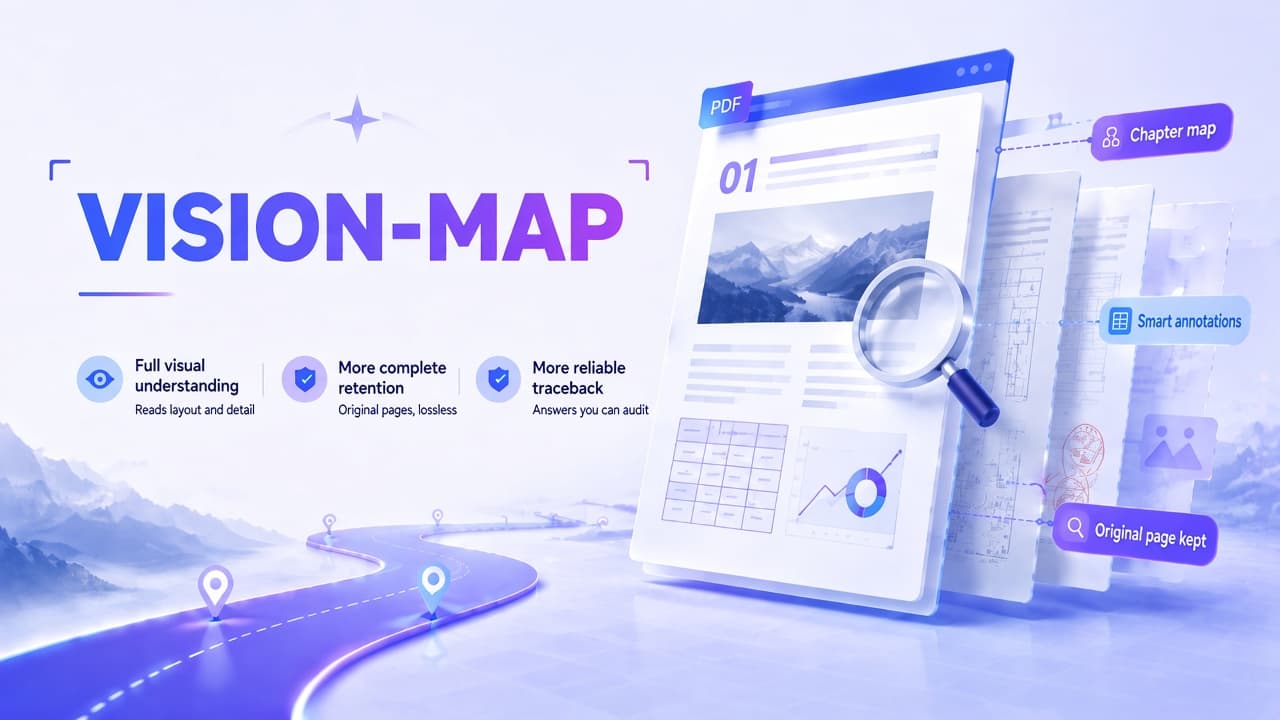
Back in the Knowhere 2.0 release, we introduced VISION-MAP (visual parsing) and Agent-Native Retrieval.
- VISION-MAP tackles visually dense files like scanned documents, slide decks, and CAD/engineering drawings by passing full pages directly to vision models to preserve layout fidelity. Meanwhile, clean, structured files like Word docs and Excel sheets go through native text parsing. Both tracks converge into a unified document memory.
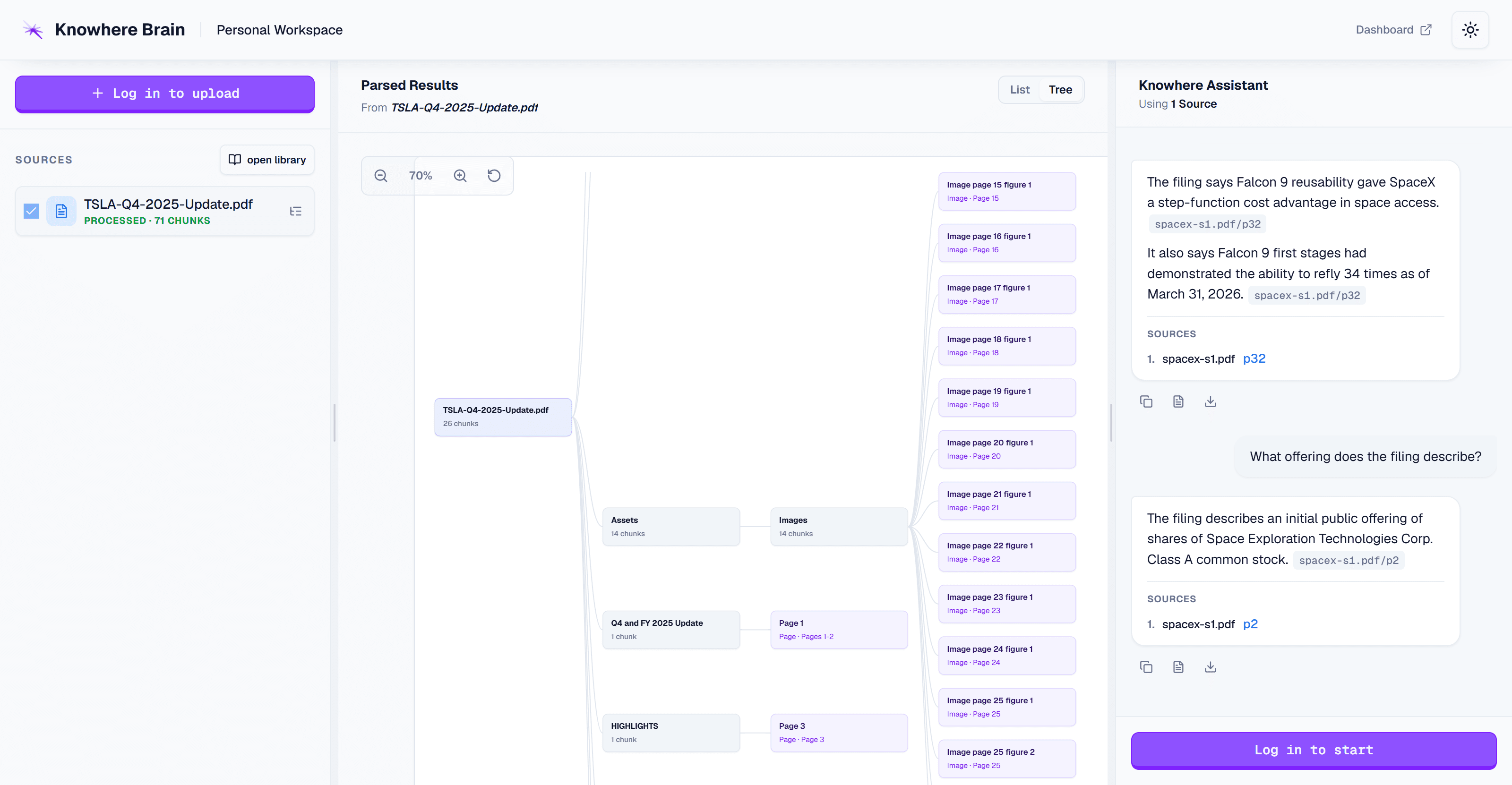
- Agent-Native Retrieval hands the steering wheel to the agent. Instead of relying on rigid, one-shot vector search, the agent inspects the document map, calls navigation tools, and charts its own retrieval path based on the complexity of the task.
Both features were built to tackle complex, multi-step reasoning over long documents. However, the longer and gnarlier the document, the more painful that initial ingestion bottleneck became.
Progressive Ingestion bridges that gap. Now, your workflows move without friction:
- Chat while uploading: In conversational apps, users can drop a 400-page manual into the chat and start asking questions immediately.
- Ingest on the fly: Agents can dynamically pull new reference docs into an active workflow without pausing to wait for a batch queue.
- No more single-page bottlenecks: A few heavy, diagram-laden pages won’t block an agent from reading the rest of the file.

Stress-Testing Knowhere on 11,945 Top AI Conference Papers
You can’t prove a document parser works just by running demos on a handful of clean, single-column PDFs. To truly test a system, you need scale, structural chaos, and real-world utility.
Academic papers from top AI conferences are the ultimate stress test.
On the surface, research papers look neat and standardized. Under the hood, they’re a parsing nightmare: double-column layouts that easily scramble reading order, equations, floating figures, and captions scattered across pages, and casual references like “see Appendix C for hyperparameters” pointing to a table buried 15 pages later. Worse yet, tens of thousands of new papers drop every year — nobody has time to read them cover-to-cover just to track a research trend.
So, we put Knowhere to work on all 11,945 papers from ACL, CVPR, ICML, and NeurIPS 2025.

We didn’t just dump raw PDF text into an LLM and ask for a summary. Instead, Knowhere parsed each paper into text chunks tagged with their exact section paths and rebuilt the full document hierarchy — so every snippet knows whether it belongs to the Methodology, Experiments, or Appendix. Armed with that structural context, an LLM classified the paper type and extracted the research problem, core contributions, methods, baselines, and experimental results. Finally, we packaged the structured metadata, raw text snippets, and section trees into a unified dataset.
Why does this matter? Because insights don’t get detached from their source. If a record says “Method X outperforms the baseline by 5%,” you — or your Research Agent — can trace the exact section path back to the source text to verify which dataset was used, whether the experimental setup was apples-to-apples, and whether that number came from the main benchmark or an ablation study.
The resulting 2025 Top ML Conference Papers Dataset covers 11,945 papers, each enriched with 28 structured fields alongside full section hierarchies and grounded source snippets.

You can use it to rapidly filter literature, map out technical trajectories, benchmark architectures, or kick off literature reviews. For a Research Agent, these aren’t 11,945 isolated PDFs anymore — they’re a structured, searchable, and verifiable knowledge base.
(Disclaimer: This dataset was generated via an automated pipeline without manual line-by-line proofreading. If you’re citing specific numbers in your own work, always double-check against the original PDF.)
The 2025 dataset is live and open-source on Hugging Face: 🤗 huggingface.co/datasets/JensCS/top-ml-conference-papers-2025

We also previously used Knowhere to compile datasets for 2023 and 2024 conferences, as well as a dedicated Embodied AI collection spanning 2023–2025. If you’re doing multi-year trend analysis or working in robotics, check them out:
- 2024 Edition: huggingface.co/datasets/JensCS/top-ml-conference-papers-2024
- 2023 Edition: huggingface.co/datasets/JensCS/top-ml-conference-papers-2023
- Embodied AI (2023–2025): huggingface.co/datasets/JensCS/embodied-ai-conference-papers-2023–2025
Wrapping Up
From VISION-MAP and Agent-Native Retrieval in Knowhere 2.0 to Progressive Ingestion today, everything we build revolves around a single goal: getting messy, real-world documents into agent workflows without the friction.
Parsing is only half the battle. Documents need to retain their structure, stay searchable, remain verifiable back to the source, and become usable the moment they enter your system. Processing 11,945 conference papers gave us a real-world stress test at scale — and showed us plenty of areas where we can push things even further.
If you’re building RAG pipelines, enterprise knowledge bases, or research agents — and you’re tired of wrestling with gnarly PDFs, slide decks, blueprints, and reports — give Knowhere a spin. Let us know what breaks and what you’d like to see next.
Document ingestion might not be the “sexiest” layer of the AI stack, but it’s foundational to making agents actually work in production. We’re going to keep making it better.
- GitHub: github.com/Ontos-AI/knowhere
Thanks again for every single star ⭐.